
Ultra-fast charging is one of the biggest advantages of modern electric vehicles, but it also raises an important question: does repeatedly charging an EV at extremely high power shorten the life of its battery?
BYD recently put its Yangwang U7 electric sedan through an unusually demanding test in Nanning, China, to see how the battery would hold up under repeated high-speed driving and ultra-fast charging.
The test covered 30,000 kilometers in just nine days, with the vehicle undergoing approximately 350 ultra-fast charging sessions along the way.
The results were surprisingly positive. According to BYD’s measurements, the battery retained 98.7% of its original capacity, representing a capacity loss of just 1.3% after the intense test.
BYD Put the Yangwang U7 Through an Extreme Battery Test
The test was designed to put considerable stress on both the vehicle and its battery.
The Yangwang U7 was driven repeatedly on high-speed tracks in temperatures reaching approximately 36°C. During the test, the sedan reached speeds of up to 240 km/h, while its battery was subjected to repeated high-power charging.
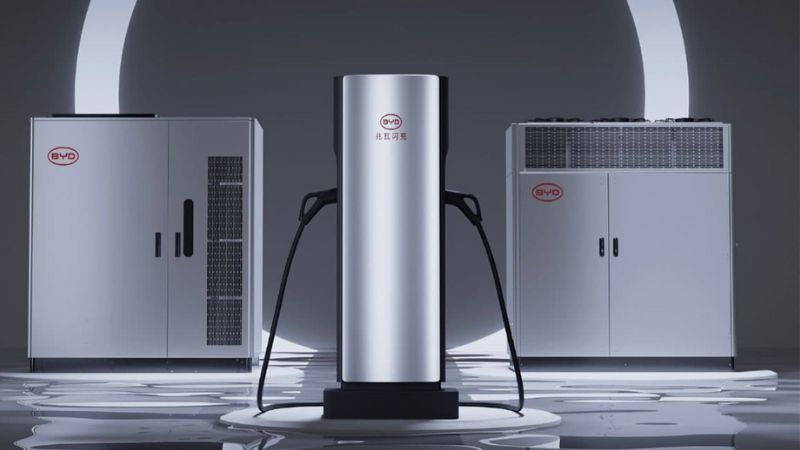
The vehicle used BYD’s Flash Charging technology, which can deliver peak charging power of up to 640 kW under suitable conditions.
According to BYD, the system can charge the battery from 10% to 97% in around nine minutes.
That combination of high-speed driving, hot weather, frequent charging, and high charging power makes the test considerably more demanding than normal daily EV use.
The Battery Lost Just 1.3% Capacity
After completing the 30,000-kilometer test and approximately 350 charging sessions, BYD reported that the battery still had 98.7% of its original capacity.
That means the measured capacity loss was only:
1.3%
For an EV battery subjected to such an aggressive testing schedule, that is a remarkably small amount of degradation.
However, it is important to put the number into context. This was a manufacturer-run test, not an independent long-term study. The results therefore provide an interesting indication of battery durability, but they should not be treated as proof that every EV battery will experience only 1.3% degradation after 30,000 kilometers.
Why Doesn’t Ultra-Fast Charging Destroy the Battery?
High-power charging generates heat, and excessive heat is a major factor that can accelerate battery degradation.
The key to making ultra-fast charging practical is therefore not simply increasing charging power. The vehicle also needs an effective battery thermal management system to keep the cells within an appropriate temperature range.
BYD’s test highlights the progress manufacturers have made in this area.
The Yangwang U7 was exposed to repeated high-power charging while operating in temperatures of up to 36°C. According to the company’s results, the battery maintained most of its original capacity despite the demanding conditions.
Efficient cooling helps control the temperature generated during high-current charging. Keeping battery cells within their intended operating range can reduce the chemical and physical stresses that contribute to long-term degradation.
Does Fast Charging Cause More Battery Degradation?
Yes, fast charging can contribute to battery degradation, but the relationship is more complicated than simply saying “fast charging damages batteries.”
Battery degradation depends on several factors, including:
- Charging power
- Battery temperature
- State of charge
- Depth of discharge
- Charging frequency
- Battery chemistry
- Thermal management
- Driving conditions
- Time and age of the battery
High charging power can put additional stress on lithium-ion cells, particularly when the battery is cold, very hot, or already at a high state of charge. Modern EVs therefore use sophisticated battery management systems to regulate charging power and temperature.
Charging speed is also not constant throughout an entire charging session. A vehicle may accept very high power when the battery is at a lower state of charge and gradually reduce charging power as the battery approaches a high state of charge.
This is one reason why charging from a low percentage to a high percentage does not mean the battery is receiving maximum power continuously.
Temperature control is one of the most important parts of an EV’s battery system.
During ultra-fast charging, large amounts of electrical energy move into the battery in a relatively short period. Some of that energy is converted into heat.
If that heat is not removed effectively, cell temperatures can rise significantly. Repeated exposure to excessive temperatures can accelerate degradation.
Modern EVs use systems such as:
- Liquid cooling
- Temperature sensors
- Battery management systems
- Active thermal control
- Charging-power adjustments
These systems work together to keep the battery within a safe operating range.
BYD’s results suggest that its thermal management and battery control systems were able to handle the extreme charging conditions used during the Yangwang U7 test.
30,000 Kilometers in Nine Days Is Not the Same as Years of Ownership
There is an important limitation to BYD’s test.
Driving 30,000 kilometres in nine days creates enormous short-term stress, but it does not reproduce every form of battery ageing that occurs during normal ownership. EV batteries experience two broad types of degradation: cycle aging and calendar aging.
Cycle aging is associated with charging and discharging the battery. Calendar aging occurs simply with the passage of time and is influenced by factors such as temperature and the battery’s state of charge while sitting unused.
A nine-day stress test cannot fully measure how the battery will behave after five, eight, or ten years of ownership.
Real-world vehicles also experience changing seasons, cold starts, long periods of inactivity, different charging habits, traffic, short trips, and varying battery states of charge.
Therefore, the reported 98.7% capacity figure should be viewed as a result from an extreme short-term durability test, rather than a prediction of long-term battery life.
What the BYD Test Really Tells Us
The most interesting part of the test is not necessarily the exact 1.3% degradation figure. Instead, it demonstrates how far EV battery technology and thermal management have progressed.
Ultra-fast charging at hundreds of kilowatts would not be practical if every charging session caused significant permanent battery damage. Modern EV manufacturers have invested heavily in battery chemistry, cooling systems, charging algorithms, and battery management software to make high-power charging more practical.
The Yangwang U7 test suggests that, under the conditions tested by BYD, repeated ultra-fast charging did not result in dramatic short-term capacity loss.
That is encouraging for EV owners who want faster charging without sacrificing battery longevity.
Should EV Owners Avoid Ultra-Fast Charging?
Not necessarily.
If your EV supports ultra-fast charging, using it occasionally is unlikely to mean that the battery will suddenly deteriorate.
However, drivers who want to maximize long-term battery health should still follow the manufacturer’s charging recommendations.
For everyday driving, slower AC charging can be more convenient and may place less thermal stress on the battery. Ultra-fast DC charging is particularly useful during long-distance trips when minimizing charging time matters.
The important point is that fast charging is one factor among many that influence battery degradation.
Keeping the battery at extreme temperatures for extended periods, frequently charging to very high states of charge, and other usage patterns can also affect long-term battery health.
Does Ultra-Fast Charging Damage EV Batteries?
The short answer is it can contribute to battery degradation, but modern EVs are designed to manage the associated heat and electrical stress.
BYD’s Yangwang U7 test provides an impressive example. After 30,000 kilometers, 350 ultra-fast charging sessions, high-speed driving, and temperatures of up to 36°C, BYD reported only 1.3% battery capacity loss.
That does not mean every EV will achieve the same result. Battery chemistry, cooling systems, charging behavior, software, environmental conditions, and vehicle design all make a difference.
It also does not prove that the battery will lose only 1.3% of its capacity over many years.
Still, the result is a strong indication that ultra-fast charging does not automatically mean rapid battery degradation, particularly when the vehicle has an effective thermal management system.
The fear that ultra-fast charging will quickly destroy an EV battery is becoming harder to support as battery technology improves.
BYD’s extreme Yangwang U7 test is a good example of what modern battery systems can withstand. The vehicle covered 30,000 kilometers in nine days, completed around 350 high-power charging sessions, and operated in temperatures reaching 36°C. Despite those conditions, BYD reported that the battery retained 98.7% of its original capacity.
There is still a major caveat: this was a manufacturer-conducted test, and nine days of extreme use cannot replicate years of real-world aging.
Even so, the results are encouraging. With better battery chemistry, thermal management, and charging controls, EVs are becoming increasingly capable of handling ultra-fast charging without the dramatic battery wear that many drivers fear.
The battery will eventually lose capacity. That is unavoidable. The more important question is how quickly that degradation happens, and modern EV technology appears to be making significant progress on that front.